Introduction
This week we have a pair of products from AGI. Agile Gear International aka AGI is an upstart brand from Neihu, Taiwan, looking to make its name in the RAM and flash storage business. We were lucky enough to visit AGI earlier this year to talk about their plans as they expand which luckily focuses on our home turf. Still, AGI has been pushing slowly into other markets, and they’re looking to break through with some compellingly good deals.
In this review, we’ll be looking at the AGI AI828 SSD particularly the 1TB option uses a Maxiotech MP1602A controller, which we’ve seen deliver some impressive performance for a DRAMless option and this is AGI’s take on such a design. Read on to find out more!

Features & Specification
- Transform Your PC Performance:Experience unparalleled speed with up to 7,400 MB/s read speeds, delivering peak performance and ultra-fast load times for your gaming PC or workstation.
- Optimized for High-Performance Users:Engineered for elite gamers and tech enthusiasts, it effortlessly handles demanding tasks like gaming, graphic design, and data analytics.
- Enhanced Reliability and Efficiency:Built with advanced 3D NAND and NANDXtend ECC technology, ensuring data integrity even during high-speed operations.
- Heatsink for Consistent Performance:Equipped with high-conductivity heat dissipation fins, it efficiently reduces heat to maintain optimal performance during your most intense gaming sessions.
- Future-Ready Innovations:The AGI AI828 is packed with cutting-edge features like SMART and TRIM commands, keeping your system running smoothly and efficiently.
| AGI AI828 SSD Specifications | |
|---|---|
| Capacity | 1TB / 2TB / 4TB / 8TB |
| Weight | 7.5g ± 0.2g |
| NAND Flash | 3D NAND |
| Operating Temperature | 0°C – 70°C |
| Storage Temperature | -40°C – 85°C |
| Interface | PCIe Gen 4 x4 |
| Form Factor | M.2 2280 |
| Shock Resistance | 1500G / 0.5ms |
| MTBF | 2,000,000 hours |
| Certifications | CE, FCC, BSMI, RoHS |
| Dimensions (L × W × H) | 80 × 22 × 3.5 mm |
| Warranty | 5 years |
| Operating Voltage | 3.3V ± 5% |
| Humidity | 5% ~ 98% RH (Non-condensing) |
| Operating Vibration | 15G (7 to 2000Hz) |
Closer Look – AGI AI828 SSD


AGI packages their products in a simple packaging with a blister plastic holder encased in a slip-on label box. This is a very simple box with colors as its main decor versus stylish graphics. I do have a problem with the lack of model details in both the front and back of this packaging, with AGI only including the model in the serial label.
While it’s easy to forgive AGI as they are still starting out, the label solution could be an issue down the line for retail channels, as it opens up the company for possible confusion from store personnel. It’s just a what-if scenario, but something worth noting.
Anyway, inside the packaging is the SSD itself, a stick-on heatsink, and a documentation leaflet.

The heatsink is a slim piece of aluminum that attaches to the component side of the SSD via adhesive.


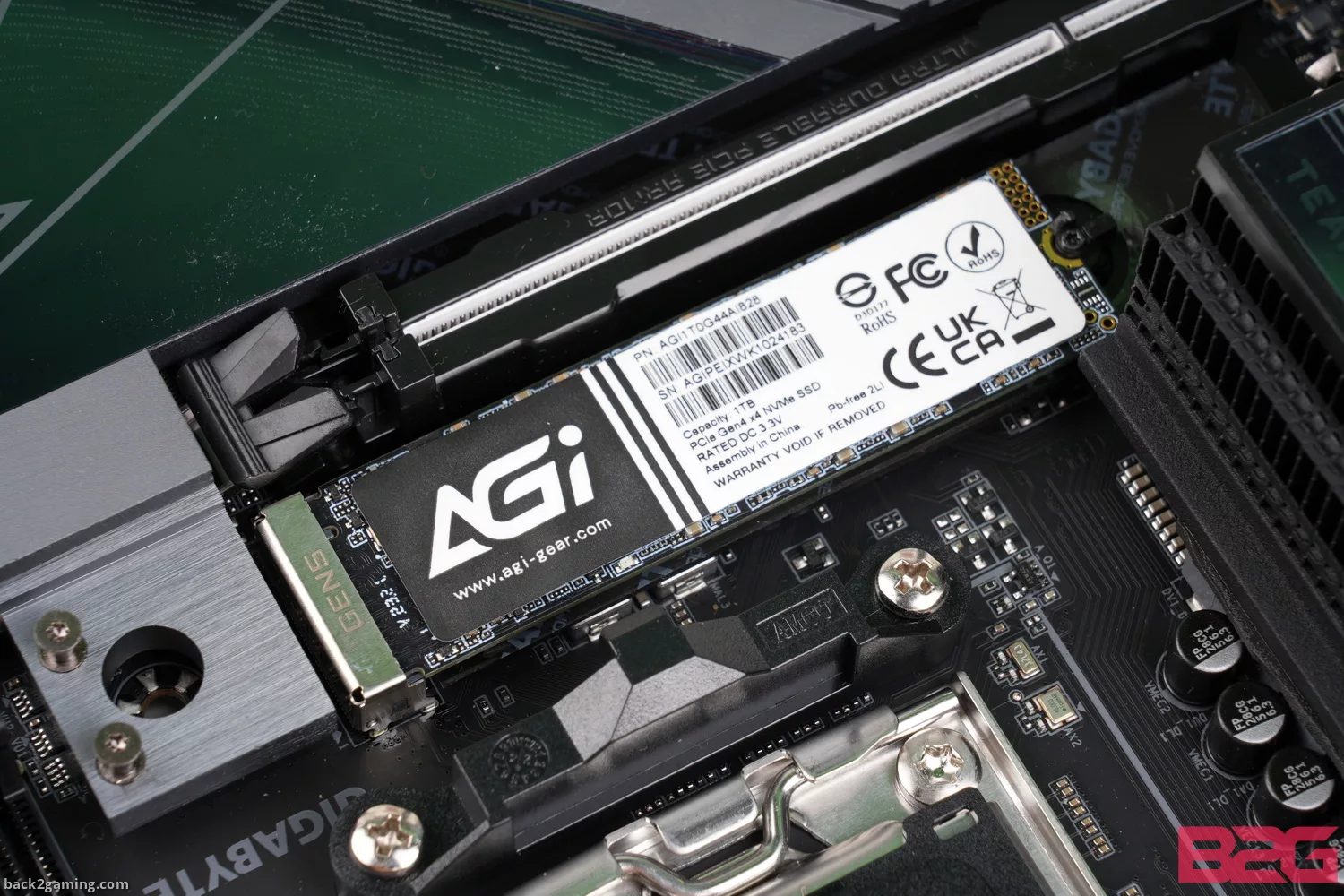
The AGI AI828 is a standard M.2 2280 size SSD, and the 1TB capacity we’re testing is single-sided with no rear components. It’s a standard affair with AGI choosing to go with a standard sticker label rather than a sticker + graphene heatspreader.
Here’s the AGI AI828 SSD installed with the heatsink off and installed.
With consumers becoming more aware of part revisions and how they can affect performance down the line, we include the key components in our SSD reviews. Below are the components used by AGI AI828 1TB SSD sample as pictured:
- Controller: Maxiotech MP1602A
- NAND: Micron B58R 232-layer 3D TLC
- DRAM: none used, HBM
Performance Testing – AGI AI828 SSD
Test Setup
Processor: Intel Core Ultra 9 285K
Motherboard: ROG STRIX Z890 GAMING-F
Memory: G.Skill TridentZ5 CK DDR5-8200
Storage: Kingston FURY Renegade SSD (OS), tested drive as listed
PSU: FSP Hydro GT Pro 1000W
Cooling: Arctic Frozr III 360
Monitor: ROG Strix XG32UQ
VGA: ASUS GTX 1050 Ti Phoenix
Our sample for this test is the AGI AI828 SSD 1TB capacity version
Linear Performance Testing
SSD performance rating, especially on write usually only achieved in optimal situations, particularly sequential transfers. In this, we use a script to write 1GB data files to fill-up the drive or until we hit the saturation point where the drive doesn’t deliver its rated performance.
Crystal DiskMark
CrystalDiskMark has been the most actively updated disk benchmark amongst all the ones we use and is effectively the most reliable. Unfortunately, version to version results are not comparable which limits the ability to extrapolate comparative data. Still its a reliable and direct benchmark. Like the previous, it allows control over test data pattern, the test data size, amount of passes and individual benchmark control.
PCMark 10 Storage Benchmark
PCMark 10 introduces a set of four storage benchmarks that use relevant real-world traces from popular applications and common tasks to fully test the performance of the latest modern drives.
3DMark Storage Benchmark
The 3DMark Storage Benchmark uses traces recorded from popular games and gaming-related activities to measure real-world gaming performance, such as:
- Loading Battlefield V from launch to the main menu.
- Loading Call of Duty: Black Ops 4 from launch to the main menu.
- Loading Overwatch from launch to the main menu.
- Recording a 1080p gameplay video at 60 FPS with OBS (Open Broadcaster Software) while playing Overwatch.
- Installing The Outer Worlds from the Epic Games Launcher.
- Saving game progress in The Outer Worlds.
- Copying the Steam folder for Counter-Strike: Global Offensive from an external SSD to the system drive.
Final Fantasy XIV Benchmark
Final Fantasy XIV has a standalone benchmark application for PC, with the mid-2024 update to the game being the Dawntrail expansion which means that we’re restarting from scratch in our testing archive for this benchmark which delivers some very nice graphical updates. A long-standing feature of the Final Fantasy XIV standalone benchmark is the loading data is captures which is a summary of all the load times between scenes in the benchmark. We take the aggregate loading times of these scenes for the total score.
Playstation 5 Testing
The Sony Playstation 5 supports storage expansion thru M.2 devices and many SSD makers are advertising their drives as supporting the Playstation 5. That said, we’ve included PS5 bandwidth testing in our reviews. We use the Playstation 5’s internal read speed test for the primary initialization. Due to how Sony designed this benchmark, our testing averages at least 5 reads with the drive formatted after a rest period for best thermal results.
Conclusion

With the abundance of SSDs in the market right now, it’s easy to dismiss AGI as just another player in the market, but the company is slowly working its way through various networks to push their brands and disrupt the market. While China-made SSD companies are also fighting in this space, AGI is a Taiwanese company trying to make its way out of its industry colleagues’ shadows.
Product-wise, the AGI AI828, along with its many other options, is pedestrian in nature, with most specs abiding by industry-standard specifications rather than glorious, bespoke technologies. The major offering that AGI boasts is its in-house packaged flash parts as well as its market-disrupting price position.
That said, as it stands, the performance of AGI AI828 SSD is similar to many Maxiotech MP1602A DRAMless options out there. It sits as the general-use performance option for the AGI 838 but is aimed at people who won’t do much writing to their drives e.g. gaming desktops and laptops, PlayStation 5, or just general home PCs that will benefit more from a responsive system than primarily read/write intensive tasks.

For around PHP5730, its main competitors are other MAP1602A + YMTC DRAMless SSDs offering the same performance but for around PHP1000 less. For our western readers, depending on where you find it but pricing will be around USD70 to USD80 for the AGI AI828 SSD, while the AGI 838 SSD with DRAM is a touch higher at >$100. Now, all these aren’t as earth-shattering a pricing as AGI puts themselves to be, but they position themselves primarily against their Taiwanese counterparts rather than those originating from China, like Fanxiang.
Regardless, as with all SSDs of this configuration, performance should be as promised, provided expectations are managed. That said, AGI is betting on their resilient supply chain rather than a buyer relationship with their NAND and controller vendor, allowing them to be quite reliable in their product offering as they don’t need to change components during a shortage.
In closing, the AGI AI828 PCIe Gen4 M.2 SSD is a by-the-numbers SSD and is great forthe purposes highlighted above. If you’re unsure if this fits your use case, ask yourself if you copy more than 300GB of files daily. If the answer is no, then the AGI AI828 should be a fit for you. AGI is now available in the Philippines along with Malaysia, Taiwan, and select Western regions, with more to come soon.
AGI backs their 828 M.2 SSD with a 3-year warranty, which could be longer. Regardless, I give it my recommended seal.