



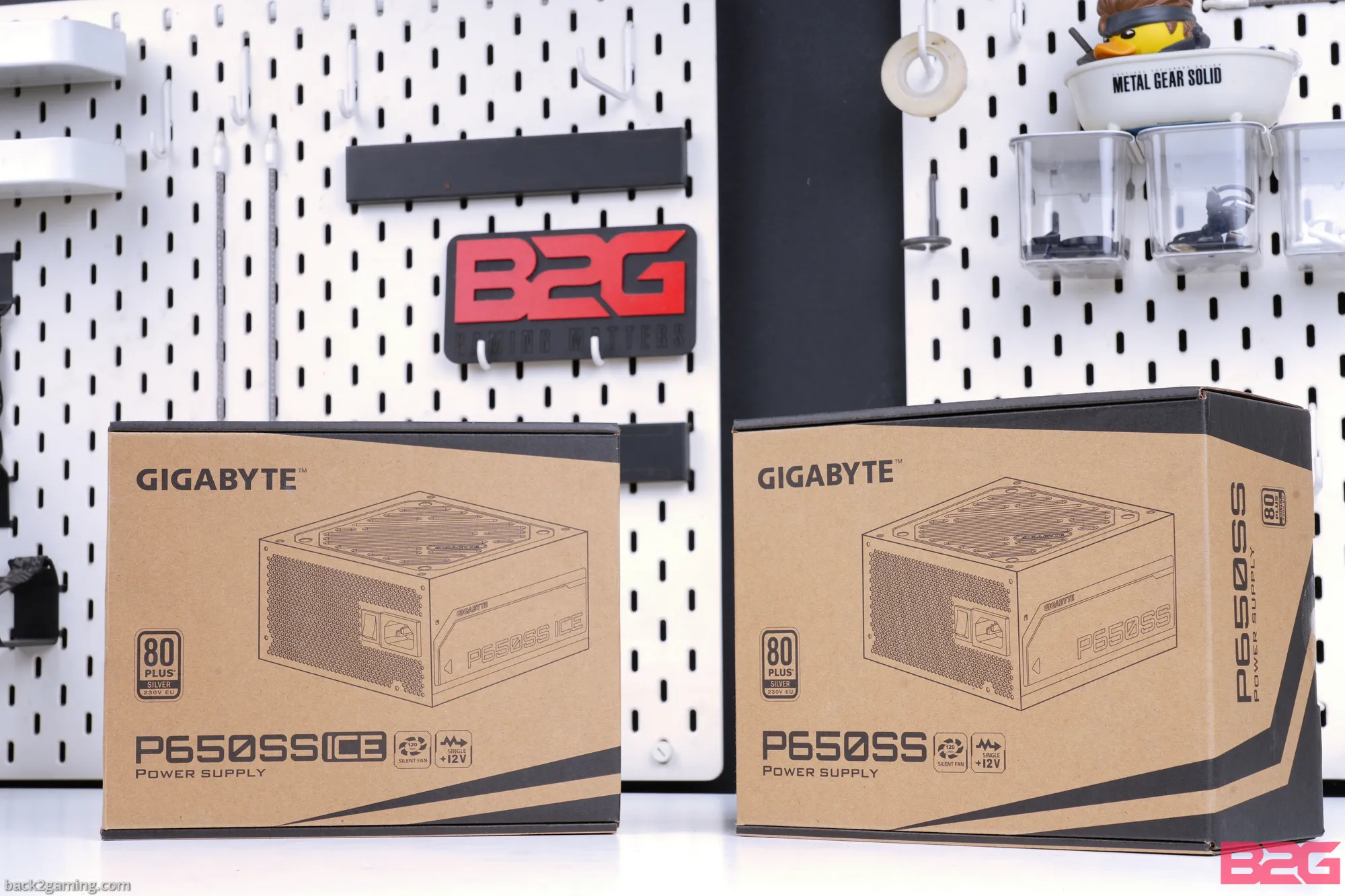
Introduction
GIGABYTE’s SS line returns 80 PLUS Silver efficiency to the budget bracket at a time when Bronze has become the default in entry builds. The GP-P650SS and its white “ICE” counterpart are positioned as cost-controlled, non-modular power supplies that aim to outclass typical Bronze units on efficiency while keeping total platform cost down. At 650 W with ATX 12V v3.0 compliance (compatible with ATX 3.1), the target use case is straightforward: mainstream gaming systems built around contemporary 6- to 8-core CPUs and mid-tier GPUs powered by traditional 8-pin PCIe connectors.
The value proposition is price-led. Locally, the P650SS/P650SS-ICE sits at ₱3,200, directly overlapping many Bronze options while offering Silver-grade efficiency and a full protection suite. There’s no modular cabling or 12V-2×6 lead here by design; the focus is dependable delivery for single-GPU rigs, sensible cable reach for common cases, and predictable thermal/acoustic behavior under real loads. We’ll validate behavior in our load-sweep and system tests; what follows is a rundown of features and a closer look at the unit’s exterior.

Features & Specification
GIGABYTE SS PSU Series
| Model | Type / Standard | Output Capacity | 80 PLUS / Efficiency | Input (Voltage / Current / Frequency) | PFC | Dimensions (L × W × H) | Fan | MTBF | Protections | Power Good | Hold-Up Time | Cable Type |
|---|---|---|---|---|---|---|---|---|---|---|---|---|
| GP-P550SS / GP-P550SS-ICE | Intel Form Factor ATX 12V v3.0 (compatible with ATX 3.1) | 550W | Silver 90% at typical load (230V EU) | 155–240 Vac / 6.3A / 50–60 Hz | Active PFC (≥0.9) | 150 × 140 × 86 mm | 120 mm FDB | >100,000 hours | OVP / OPP / SCP / UVP / OCP / OTP | 100–150 ms | >16 ms | Flat, all black |
| GP-P650SS | Intel Form Factor ATX 12V v3.0 (compatible with ATX 3.1) | 650W | Silver 90% at typical load (230V EU) | 155–240 Vac / 6.3A / 50–60 Hz | Active PFC (≥0.9) | 150 × 140 × 86 mm | 120 mm FDB | >100,000 hours | OVP / OPP / SCP / UVP / OCP / OTP | 100–150 ms | >16 ms | Flat, all black |
| GP-P750BS | Intel Form Factor ATX 12V | 750W | Bronze (230V EU) 88% at typical load | 200–240 Vac / 6 A / 50–60 Hz | Active PFC (≥0.9) | 150 × 140 × 86 mm | 120 mm FDB | >100,000 hours | OVP / OPP / SCP / UVP / OCP / OTP | 100–150 ms | >16 ms | Embossed, all black |
PSU Configuration
| Model | ATX / CPU | PCIe (6+2-pin) | SATA / Peripheral |
|---|---|---|---|
| GP-P550SS / GP-P550SS-ICE |
|
|
|
| GP-P650SS |
|
|
|
| GP-P750BS |
|
|
|
Official product page (GP-P650SS) / (GP-P650SS-ICE)
GIGABYTE PSU PH MSRP
| Model | Notes | Price (PHP) |
|---|---|---|
| GP-UD750GM-PG5 | Gold Modular, 12V-2×6 / PG5 | 6,280 |
| GP-UD750GM | Gold Modular | 5,500 |
| GP-P750BS | Bronze, Non-Modular, PCIe 3.0 | 3,800 |
| GP-P650SS | Silver, Non-Modular (Black), ATX 3.0 | 3,200 |
| GP-P650SS-ICE | Silver, Non-Modular (White), ATX 3.0 | 3,200 |
| GP-P550SS | Silver, Non-Modular, ATX 3.0 | 2,600 |
| GP-P550SS-ICE | Silver, Non-Modular (White), ATX 3.0 | 2,600 |
Note: Valid as of Q3 2025. Check with your local dealer for actual pricing.
Closer Look


The GP-P650SS keeps installation constraints in mind with a 140 mm depth inside a standard 150 × 86 mm ATX frame, making it compatible with tighter mid-towers and mATX layouts. The housing is clean and understated: matte black for the P650SS and matte white for the ICE, with matching side decals that won’t clash with neutral builds or themed setups.


Intake is through a 120 mm fan behind a stamped grille; exhaust vents use a full-height honeycomb cutout beside the mains rocker and IEC inlet. There’s no lighting, no cosmetic cutouts, and no switches to manage—just a straightforward exterior that prioritizes airflow and ease of placement. Labels are conventional: model/branding on the sides for windowed cases, and a top label with the rating table for quick reference during assembly.


Cabling is non-modular by design. All leads are flat, which helps routing behind the motherboard tray and reduces bulk at the PSU shroud pass-through. Lengths are practical for mainstream cases: a 600 mm 24-pin ATX, a daisy-chained EPS cable (650 mm + 120 mm) to cover single- or dual-CPU headers, two discrete PCIe 6+2 cables at 600 mm each, plus two storage chains that split SATA and 4-pin peripheral plugs for cleaner distribution across drive cages and accessories.

The ICE variant carries the look across the harness as well, keeping the presentation consistent for white builds, this is includes the zipties and even the AC power cord.

Overall, the exterior is utilitarian and consistent with the brief: a compact shell, flat cabling with sensible reach, and the connector mix that mainstream single-GPU systems still rely on. We’ll detail thermal behavior, acoustics, and voltage stability in the next section using our own load testing.
Testing and Observation
Test Setup
Processor: Intel Core Ultra 9 285K
Motherboard: ROG Strix Z890 GAMING-F
Memory: G.Skill TridentZ5 CK DDR5-8200 48GB C40 1.4v
Storage: Kingston FURY Renegade SSD (OS), tested drive as listed
PSU: as reviewed
Cooling: Arctic Frozr III 360
Monitor: ROG Strix XG32UQ
VGA: varies by load required
We’re currently developing a PSU testing methodology using actual components to generate the load. That said, most modern systems will use the 12V mainly, so I’m currently studying ways to create loads for the 3.3V and 5V that replicate real-world use cases.
Loads are measured inline using either a combo setup of Benchlab or Powenetics v2 with an AC-side load meter prototype. Tests are done in an open test bench for ambient while hotbox test is done by feeding the GPU exhaust to the PSU while enclosed in a box to increase ambient temps. Nothing fancy.
Tests are done in native Philippine outlet voltage of 220V.
Loads are generated by OCCT – Power Test with CPU TDP adjusted for PSU max capacity along with GPU used for testing. OCCT Stability Test is now available directly on Steam for both Windows and Linux.
Thanks to Aris Mpitziopoulos of Cybenetics and Hardware Busters for all the support in our power-related efforts.
Ambient Test


Deviation
| Rated (W) | Measured Load (W) | Load % | Avg Voltage (V) | Deviation (mVpp) | Samples |
|---|---|---|---|---|---|
| 650 | 679.59 | 104.6% | 11.667 | 31.0 | 1499 |

Hot Box Results


Deviation
| Rated (W) | Measured Load (W) | Load % | Avg Voltage (V) | Deviation (mVpp) | Samples |
|---|---|---|---|---|---|
| 650 | 678.84 | 104.4% | 11.690 | 31.0 | 1501 |

Is safety triggering?
The GIGABYTE P650SS tops out at ~800W load before cutting off.
Conclusion and Recommendation
GIGABYTE has a 750W version of this power supply, but it only has an 80 PLUS Bronze efficiency rating. Focusing on the sample capacity we have at 650W, we tested both black and white samples and obviously, they perform the same. There is a cheaper 550W version, also an 80 PLUS Silver rated model. Both 550W and 650W GIGABYTE SS series power supplies are positioned to compete with entry-level branded Bronze PSUs in an effort to carve out a good portion of the entry-level market, which has sizable install bases in Southeast Asian markets.

Available in both black and white, it tries to appeal to a wider audience looking to do themed builds but don’t want to go crazy on Gold-series PSUs which have been the favored product of most PSU makers as of late, pushing onto mainstream builds which has led to a boom in 80 PLUS Bronze no-name brands popping out of Shenzhen Sorting Centre.
The GIGABYTE P650SS is a decent power supply that tries to one-up its rivals by providing a higher efficiency rating but is capable enough to deal with mainstream systems rocking system combos of a 125W CPU + a 300W GPU which should give upgraders some headroom if they start building their systems with the GIGABYTE P650SS but holds off on replacing it with a larger PSU down the line after an upgrade.
For systems running 125W and 65W CPUs, its got plenty of leg room for a GPU up to the upper mainstream graphics cards right now. Staying within the efficiency curve still keeps us at the more modest 65W CPU + 220W GPU which is still plenty of power for modern systems so anyone rocking a Ryzen 7600X/9600X or midrange 13400F or Core Ultra 5 can feasibly pop-in up to an RTX 5070. Its important to note though, that this is an ATX3.0 power supply with no native 12v-2×6 (12VHPWR) connector.
Overall, it’s a straightforward solution that focuses more on what matters: efficiency and value. Its a good attempt at GIGABYTE into earning back its customer base for power supplies, and in our part of the world, where price is a key deciding factor, it enters at a fairly competitive spot and is a decent recommendation.