



NVIDIA CEO Jensen Huang returned to the COMPUTEX stage in Taipei to deliver his 2025 keynote, presenting a detailed roadmap for the company’s continued push into AI infrastructure, robotics, enterprise computing, and next-generation hardware. The session focused heavily on the evolving role of data centers, which Huang now redefines as “AI factories”—energy-powered facilities that generate tokens instead of parts, data instead of materials.
From AI Factories to Nation-Scale Compute

Huang’s address positioned AI not as an emerging field but as a foundational infrastructure on par with electricity and the internet. Drawing parallels to previous industrial revolutions, he described AI as a global necessity—something every region, sector, and organization will require.
The presentation reiterated that NVIDIA no longer sees itself as a traditional technology company, but as a full-stack infrastructure provider. Huang cited the company’s detailed five-year roadmap as essential to helping governments and enterprises plan AI buildouts involving land, energy, and compute resources.
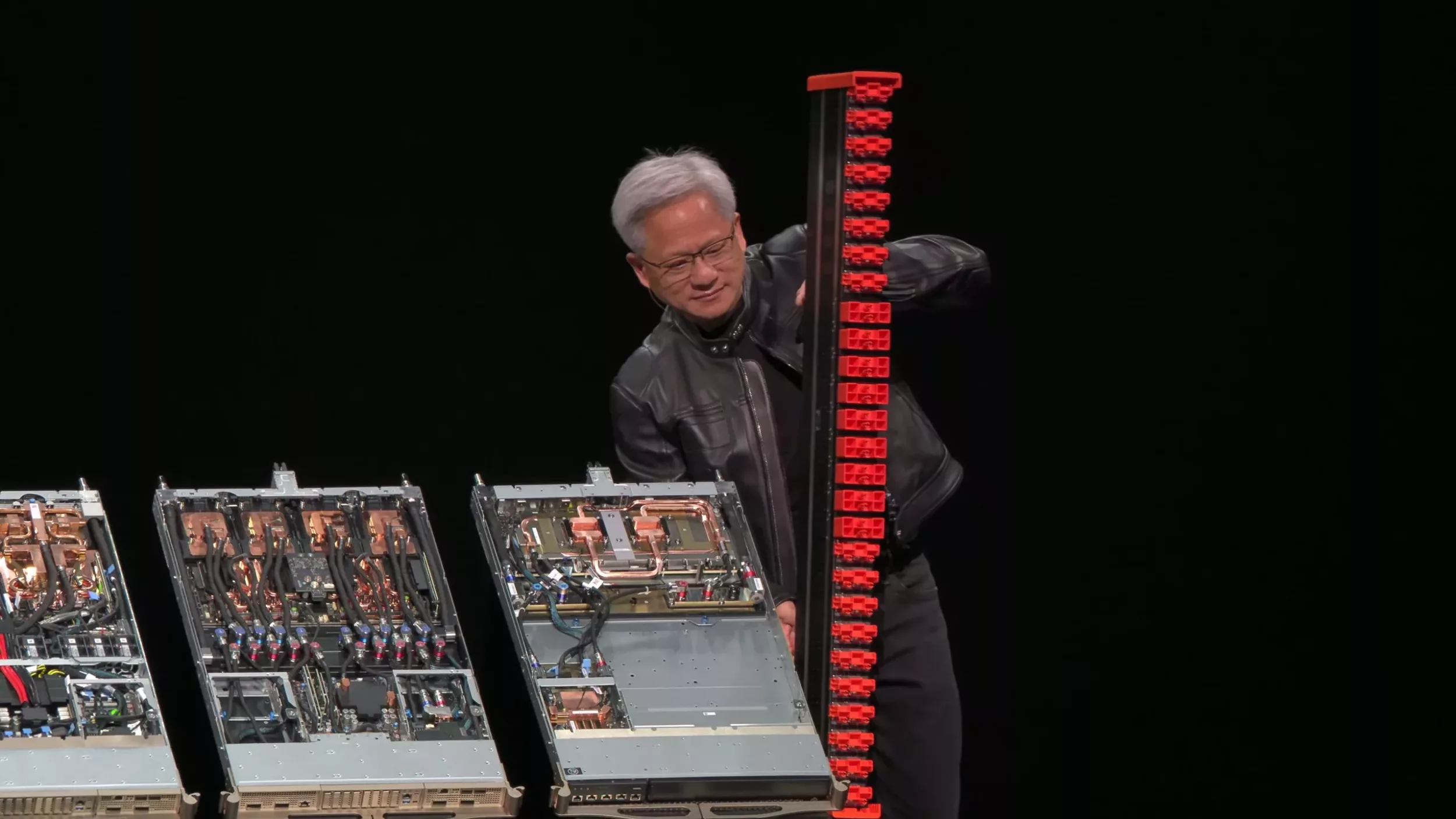
NVIDIA’s AI infrastructure model revolves around modular, high-density compute systems based on its Grace Blackwell architecture. Highlighted was the NVL72 “One Giant GPU”, a vertically and horizontally scalable GPU array featuring enhanced NVLink connectivity, enabling massive throughput and shared memory performance across 72 GPUs per rack.
Grace Blackwell, DGX Systems, and NVLink Fusion

Huang formally unveiled the Grace Blackwell GB300, a liquid-cooled upgrade over the GB200, with a 1.5x improvement in inference performance and double the network bandwidth. NVIDIA’s NVLink Fusion was also introduced, allowing integration of third-party accelerators and chiplets into NVIDIA’s compute fabric—signaling a move toward semi-custom AI infrastructure deployments.

DGX Spark and DGX Station systems were announced as personal-scale options for developers and researchers, enabling AI-native development without reliance on cloud provisioning.
For our tests of one of these personal AI systems, read our GIGABYTE AI TOP ATOM 128GB DGX Spark review, covering local AI performance, power consumption and thermals.
Agentic, Physical AI and Robotics Platforms

On the AI software front, Huang spoke at length about agentic AI—systems capable of reasoning, planning, and tool use—bridging the gap between chat-based LLMs and functional digital workers. This concept extends into physical environments through what he calls “Physical AI”, where models reason about inertia, causality, and environmental physics.

NVIDIA’s Isaac GR00T platform and the Jetson Thor processor were presented as the backbone for generalized robotics. Accompanying this was the release of Isaac GR00T N1.5, an open pre-trained robotics model, and the introduction of Newton—a high-precision GPU-accelerated physics engine for realistic robotics simulation, developed in partnership with DeepMind and Disney Research.
Enterprise AI and the Rise of AI-Native IT

In the enterprise sector, Huang introduced the RTX PRO platform, an enterprise-grade system designed to support traditional x86 workloads alongside agentic AI deployment. Key highlights included support for AI-native applications and the integration of AI-Q, NVIDIA’s semantic data query platform, into enterprise storage stacks.

The goal, according to Huang, is a future where AI agents—digital coworkers—augment existing workforces to offset projected labor shortages. NVIDIA’s AIOps platform is being developed to manage this new class of AI infrastructure, combining orchestration, fine-tuning, and governance tools.
National-Scale Commitment: Taiwan AI Infrastructure

In a regional context, Huang announced a collaboration with Foxconn, TSMC, and the Taiwanese government to build a dedicated AI supercomputing infrastructure within Taiwan, cementing the island’s role as a strategic hub for global AI development.

He also unveiled NVIDIA Constellation, a new office and R&D complex to be constructed in the Beitou-Shilin Science Park, marking a significant expansion of NVIDIA’s presence in Taiwan.
Jensen Huang concluded by reinforcing the idea that the AI industry is not simply an extension of computing—it is its own industrial category, on pace to become a multi-trillion-dollar sector. With NVIDIA positioned at every layer from hardware and systems to frameworks and simulation, the company is doubling down on what Huang terms a unified architecture for AI factories, enterprise agents, and robotics.


