




If you are swapping graphics cards, chasing a crash that will not go away, or troubleshooting performance that dropped after a driver update, DDU is usually the tool people point you at. This guide covers what DDU is, when it is actually the right call, and how to use it properly on Windows 10 and Windows 11.
- What Is DDU (Display Driver Uninstaller)?
- Should You Use DDU?
- Before You Start
- Step 1: Download DDU
- Step 2: Extract the Archive
- Step 3: Get Into Safe Mode
- Step 4: Launch DDU
- Step 5: Select GPU and Your Vendor
- Step 6: Clean and Restart, or Clean and Shut Down
- Step 7: Return to Normal Startup
- Step 8: Install Your New Driver
- Common DDU Problems and Fixes
- Frequently Asked Questions
- What does DDU actually do?
- Is DDU safe to use?
- Do I need Safe Mode to run DDU?
- Should I use DDU if I have performance issues?
- Does DDU delete my games or files?
- Do I need DDU when switching from NVIDIA to AMD?
- Which DDU version should I use?
- Do I need to run DDU every time I update my graphics driver?
- The Short Version
What Is DDU (Display Driver Uninstaller)?
DDU, short for Display Driver Uninstaller, is a free third-party utility from Wagnardsoft that completely removes graphics drivers from Windows, including the leftovers that the normal uninstaller leaves behind.
That distinction is the whole point. When you uninstall a GPU driver through Windows Settings or the vendor’s own installer, the process usually leaves registry entries, driver store packages, folders and configuration files in place. Most of the time that is harmless. When it is not harmless, it produces exactly the symptoms people spend days chasing: black screens, driver timeouts, crashes on launch, control panels that refuse to open, or a new card that performs worse than the old one.
DDU wipes all of it and returns Windows to a state where the next driver install has nothing to conflict with.
It is not a performance tool. It does not make your GPU faster. It removes a variable.
Should You Use DDU?
Not always, and this is worth getting right before you reboot into Safe Mode for no reason.
Use DDU when:
- You are switching between GPU brands – NVIDIA to AMD, AMD to Intel, and so on. This is the strongest case for it, and skipping it here causes real problems.
- You are getting crashes, black screens, driver timeouts, or TDR errors that started after a driver update.
- A driver install fails partway through, or the vendor control panel will not open.
- You have rolled back and forward through several driver versions troubleshooting something and want a clean baseline.
- You bought a used graphics card and want a clean slate.
You probably do not need DDU when:
- You are doing a routine driver update on a stable system. The vendor installer’s own clean-install option is enough.
- You are upgrading to a newer card from the same brand and everything is currently working fine.
- You are chasing general performance issues with no graphical symptoms. If the problem is stutter in one game, thermals, or a CPU bottleneck, wiping your drivers will not touch it. Rule those out first.
The honest summary: DDU is a troubleshooting tool and a brand-switching tool. It is not part of routine maintenance, and running it “just in case” mostly costs you time.
Before You Start
Download the driver you plan to install first. Once DDU has done its job, you will be sitting on a basic display driver, and if the machine cannot get online easily, you want the installer already on disk.
- NVIDIA: nvidia.com/en-us/geforce/drivers
- AMD: amd.com/en/support
- Intel: Intel Arc graphics drivers
Expect the screen to flicker, go black briefly, or drop to a low resolution during the process. That is normal. Windows falls back to a basic display adapter once the real driver is gone.
DDU is portable and does not install itself, so there is nothing to remove afterwards.
Step 1: Download DDU
Get DDU from the official Wagnardsoft forum thread: wagnardsoft.com/forums/viewtopic.php?t=4699
The thread carries the changelog, system requirements and the direct download. Choose the “Download DDU (Portable / self-extracting)” link.
Always download from Wagnardsoft directly. DDU is heavily mirrored across download-aggregator sites, and those copies are frequently bundled with junk or are several versions behind. The version number in the filename will match whatever the current release is, so do not worry if it differs from any screenshot you have seen , always use the latest.

Step 2: Extract the Archive
The download is small. Run the executable from your Downloads folder and it will extract DDU into a folder alongside it. This is a self-extracting archive, not an installer, so nothing is added to your system.

Step 3: Get Into Safe Mode
Do you still need Safe Mode? Wagnardsoft still recommends it, and it remains the most reliable way to run DDU. Windows will happily reinstall a display driver in the background the moment it notices one missing, and Safe Mode prevents that from happening mid-clean.
You have two ways in.
Option A: let DDU do it (easier). Launch DDU normally. It will detect that you are not in Safe Mode and offer to restart Windows into it for you. Accept, and DDU will be waiting when the machine comes back up. This is the method most people should use.
Option B: msconfig (manual). Press the Windows key, type msconfig, and open System Configuration. On the Boot tab, tick Safe boot and click OK. Windows will prompt you to restart.


If you use Option B, remember to untick Safe boot afterwards or Windows will keep booting into Safe Mode. Step 7 covers this.
Step 4: Launch DDU
Once you are in Safe Mode, open the folder DDU extracted to and run Display Driver Uninstaller.exe.

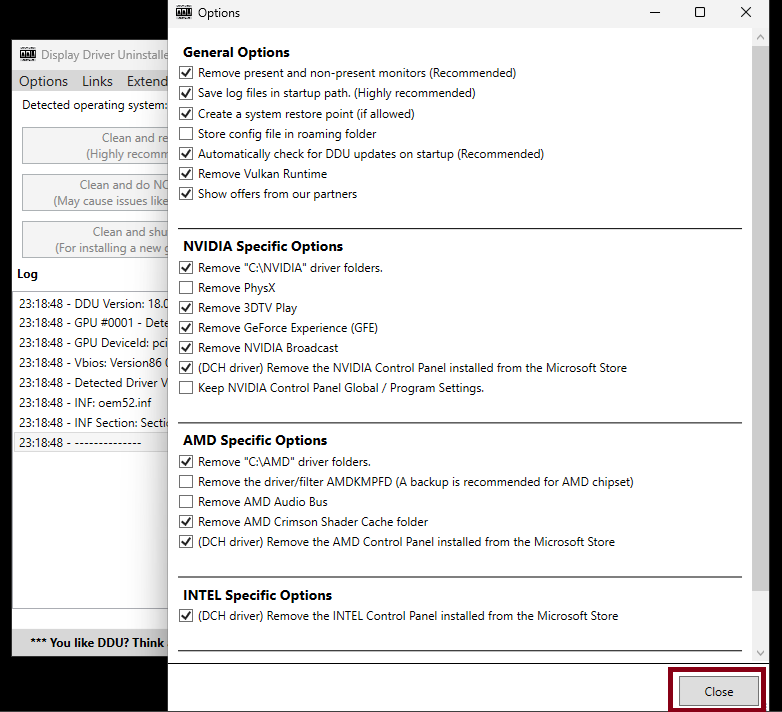
On first launch, DDU shows an options window. The defaults are correct for almost everyone; leave them alone and click Close. The only option worth considering is preventing Windows from automatically installing drivers, which is useful if you want to control exactly which version goes on.
Step 5: Select GPU and Your Vendor
On the right side of the window, set Select device type to GPU, then choose your manufacturer, NVIDIA, AMD, or Intel, from the dropdown below it.
If you are switching brands, select the brand of the card currently installed, not the one you are moving to.


Step 6: Clean and Restart, or Clean and Shut Down
DDU gives you three buttons, and picking the right one matters:
- Clean and restart: use this if you are keeping the same graphics card and just reinstalling drivers.
- Clean and shut down: use this if you are physically swapping the card. The machine powers off so you can change hardware before it boots again.
- Clean, no restart: only for stacking multiple cleans, for example removing both an NVIDIA driver and an old Intel one. Reboot before installing anything.
DDU will work through the removal and act on your choice. Expect a black screen and resolution changes along the way.
Step 7: Return to Normal Startup
If you used Option B in Step 3, open msconfig again, select Normal startup on the General tab, click OK and restart. If you let DDU handle Safe Mode for you, it reverts this automatically and there is nothing to do.

Step 8: Install Your New Driver
Run the installer you downloaded in the preparation step. Because DDU has cleared everything out, this behaves like a first-time install on a fresh Windows build.
Do this promptly. If you leave the machine sitting on a basic display driver with an internet connection, Windows Update will eventually push its own GPU driver , which is usually old, and which puts you back where you started.
Common DDU Problems and Fixes
Windows reinstalls the driver by itself before you can. This is the most common complaint. Either install your driver immediately after reboot, or use DDU’s option to prevent Windows from downloading drivers automatically. Disconnecting from the internet until your installer has finished also works.
The screen is black or stuck at low resolution afterwards. Expected. You are on the Microsoft Basic Display Adapter until a real driver goes on. Install the driver and it resolves.
Windows keeps booting into Safe Mode. You left Safe boot ticked in msconfig. Untick it, click OK, restart.
DDU will not open, or antivirus quarantines it. Some security tools flag driver-removal utilities as a matter of course. Confirm you downloaded from Wagnardsoft, then allow it or add a temporary exclusion.
The problem is still there after a clean install. Then it was probably not the driver. Look at thermals, power delivery, memory instability, or the card itself. DDU eliminates a variable , if the symptom survives it, the cause is elsewhere.
You use a laptop with switchable graphics. Be deliberate. Remove and reinstall both the integrated and discrete drivers, and prefer your laptop manufacturer’s driver package where one is offered, since OEM builds sometimes carry required power and display customisations.
Frequently Asked Questions
What does DDU actually do?
It removes graphics drivers along with the registry entries, driver store packages, folders and configuration files that a standard uninstall leaves behind, returning Windows to a clean state for the next install.
Is DDU safe to use?
Yes, when downloaded from the official Wagnardsoft thread. It has been a standard part of PC troubleshooting for over a decade. Avoid third-party mirrors, which are often outdated or bundled.
Do I need Safe Mode to run DDU?
It is strongly recommended, and it is what Wagnardsoft advises. Outside Safe Mode, Windows can reinstall a driver while DDU is working. Modern DDU can reboot you into Safe Mode itself, so there is little reason to skip it.
Should I use DDU if I have performance issues?
Only if the symptoms are graphical, crashes, black screens, driver timeouts, or trouble that began after a driver update. For general stutter or low frame rates with no visual faults, the cause is more likely thermals, a CPU bottleneck, or in-game settings. DDU will not help with those.
Does DDU delete my games or files?
No. It only touches display drivers and their associated files. Games, documents, and other software are untouched.
Do I need DDU when switching from NVIDIA to AMD?
This is the single best reason to use it. Leftover files from a rival vendor’s driver are a well-known source of instability, and DDU is the cleanest way to avoid that.
Which DDU version should I use?
Always the latest one from the Wagnardsoft thread. It is updated regularly to keep pace with new driver releases and Windows changes, and an old build may not fully clean a current driver.
Do I need to run DDU every time I update my graphics driver?
No. On a stable system, the vendor installer’s own clean-install option is sufficient. Save DDU for brand switches and actual troubleshooting.
The Short Version
DDU is the tool you reach for when you are switching GPU brands or when a driver problem will not go away , not something to run on a schedule. Download it from Wagnardsoft, boot into Safe Mode, select GPU and your vendor, clean and restart, then install your new driver before Windows Update gets there first.
Done properly, it takes about ten minutes and eliminates the single most common cause of graphics instability on a Windows machine.


Thank you worked perfectly to throw back to a stable nvidia driver (they know how to mess up things haha)