




Introduction & Specification
COLORFUL is shaping up to have a very successful launch this generation despite the numerous challenges the China-based company has to go through. Despite the Chinese New Year break coinciding with retail availability of the RTX 5080, COLORFUL’s key markets outside of China notably SEA have seen day-1 stocks of the COLORFUL RTX 5080 ULTRA W OC arriving in decent numbers.
- Introduction & Specification
- Closer Look
- Power Draw, Temperature and Clock Speed Analysis
- Performance Testing – Setup & Methodology
- Counter-Strike 2
- DOTA 2
- PUBG Battlegrounds
- Rainbow Six Siege
- Baldur’s Gate 3
- Black Myth Wukong
- Cyberpunk 2077
- F1 2024
- Ghost of Tsushima: DIRECTOR’S CUT
- Hogwarts Legacy
- Horizon Forbidden West
- The Last of Us Part 1 Remastered
- Marvel’s Spider-Man 2
- Microsoft Flight Simulator 2024
- Ratchet & Clank: Rift Apart
- Resident Evil 4
- Starfield
- Warhammer 40,000: Space Marine II
- Ray Tracing
- DLSS4
- Conclusion
With the CNY break backlog overcame, the pricing issue follows which in some regions like the Philippines, COLORFUL is offering this card close to our MSRP (NVPH RTX 5080 MSRP PHP72,860) making this card easily one of the most accessible RTX 5080 on launch for the Philippine market and with supplies looking healthy, COLORFUL is well on their way to have an install-base ready to either extol or castigate COLORFUL on their experience.
With that said, this review will be focusing on the performance of the COLORFUL iGAME RTX 5080 ULTRA W OC, easily one of the most competitive RTX 5080 in the Asia market in terms of availability. We’ve worked with COLORFUL since their venture to international markets with the GTX 10-series and 10 years later, the company has been carving a name for themselves to ultimately cement their place in the global market, all while bearing the weight of a geopolitcal baggage. Read on to find out more in this review!
NVIDIA RTX 50
NVIDIA’s RTX 50-series launch was the worst-kept secret of 2024 and leading up to the first of 2025, the tech world was ready to see what NVIDIA has in-store in hopes of turning things around for the DIY PC space which has been seeing dwindling interest lately no thanks to both Intel and AMD, albeit the Ryzen 7 9800X3D was an expected exception.
Powered by Blackwell, NVIDIA’s domination over machine learning and deep learning has put ray tracing to the wayside focusing on improving the visual experience with the introduction of Neural Rendering.
NVIDIA describes neural rendering as their direction for modern graphics integrating generative AI models to assist in scenes going further than just ray reconstruction. Blackwell introduces Mega Geometry but the most notable development here amongst all is the introduction of Multi-Frame Generation. The next stage of DLSS, DLSS4 brings Multi-Frame Generation enabled by the Blackwell architecture enabling up to 3 more frames to be generated following a single rendered frame, effectively a 4x multiplier. A newer Transformer-based model for DLSS bumps up all DLSS releases benefiting not just the RTX 50 but even previous RTX cards.
All of this is built on a more conservative hardware stack on the GB203 silicon for the RTX 5080. Packing 10752 CUDA cores complemented by 16GB of GDDR7 video memory wired to a 256-bit wide bus resulting in a 960GB/s bandwidth versus the 770GB/s of the RTX 4080.
The RTX 5080 features a base clock of 2295Mhz and a turbo clock of 2617Mhz. Our review unit has a toggle to bump Turbo to 2655Mhz.
| Model | CUDA Cores | Base Clock (GHz) | Boost Clock (GHz) | Memory Clock (Gbps) | GPU | Memory | Memory Interface Width | Ray Tracing Cores | Tensor Cores | AI TOPS | Ray Tracing Performance (TFLOPS) | DLSS Version |
|---|---|---|---|---|---|---|---|---|---|---|---|---|
| GeForce RTX 5080 | 10,752 | 2.30 | 2.62 | 30 | GB203 | 16 GB GDDR7 | 256-bit | 4th Gen | 5th Gen | 1,801 | 171 | DLSS 4 |
| GeForce RTX 5090 | 21,760 | 2.01 | 2.41 | 28 | GB202 | 32 GB GDDR7 | 512-bit | 4th Gen | 5th Gen | 3,352 | 318 | DLSS 4 |
| GeForce RTX 4090 | 16,384 | 2.23 | 2.52 | 21 | AD102 | 24 GB GDDR6X | 384-bit | 3rd Gen | 4th Gen | N/A | 191 | DLSS 3 |
| GeForce RTX 4080 | 9,728 | 2.21 | 2.51 | 22.4 | AD103 | 16 GB GDDR6X | 256-bit | 3rd Gen | 4th Gen | N/A | 112 | DLSS 3 |
| GeForce RTX 3080 | 8,704 | 1.44 | 1.71 | 19 | GA102 | 10 GB GDDR6X | 320-bit | 2nd Gen | 3rd Gen | N/A | 58 | DLSS 2 |
| GeForce GTX 1080 Ti | 3,584 | 1.48 | 1.58 | 11 | GP102 | 11 GB GDDR5X | 352-bit | N/A | N/A | N/A | N/A |
Official product page – COLORFUL iGAME RTX 5080 ULTRA W OC
Closer Look


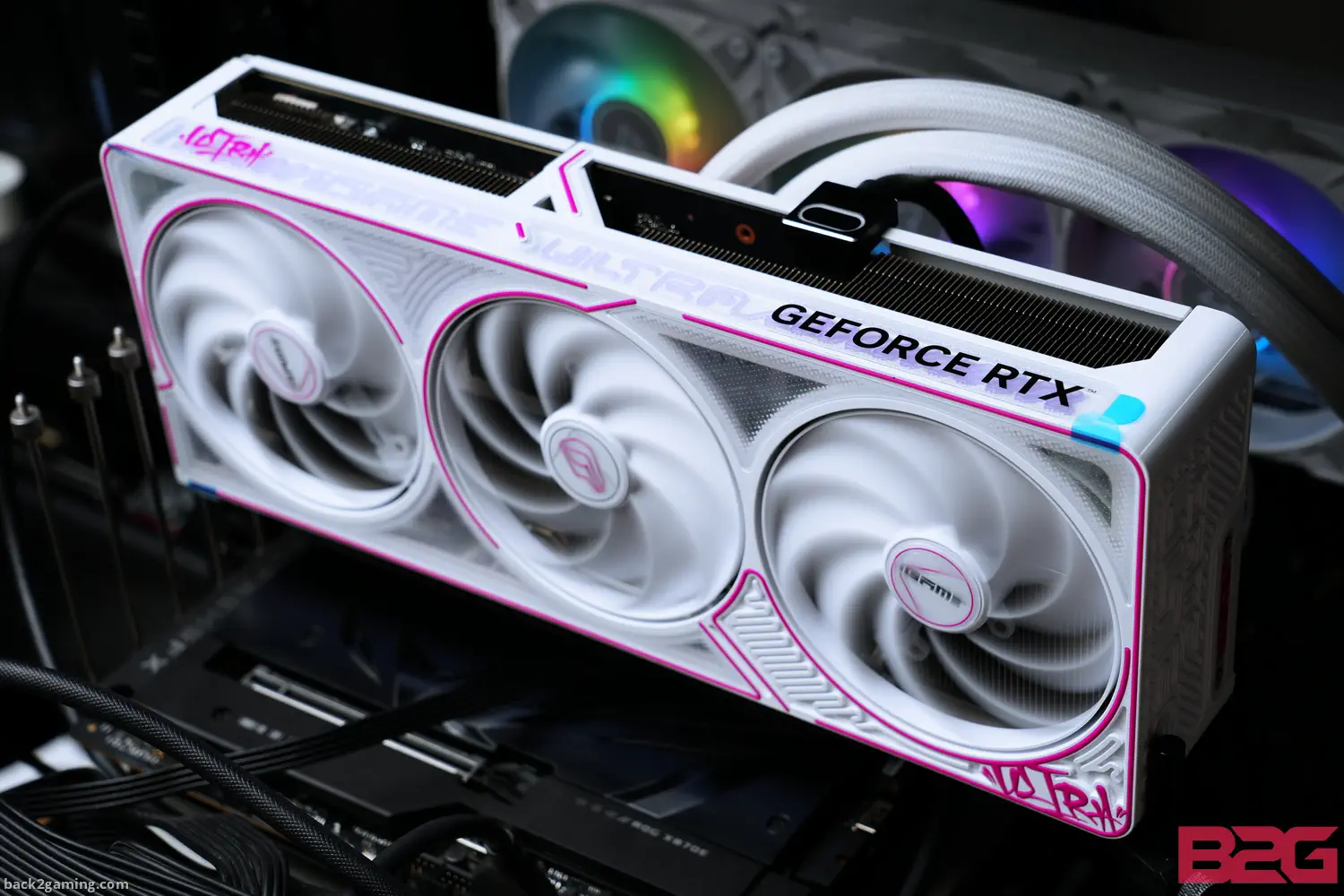
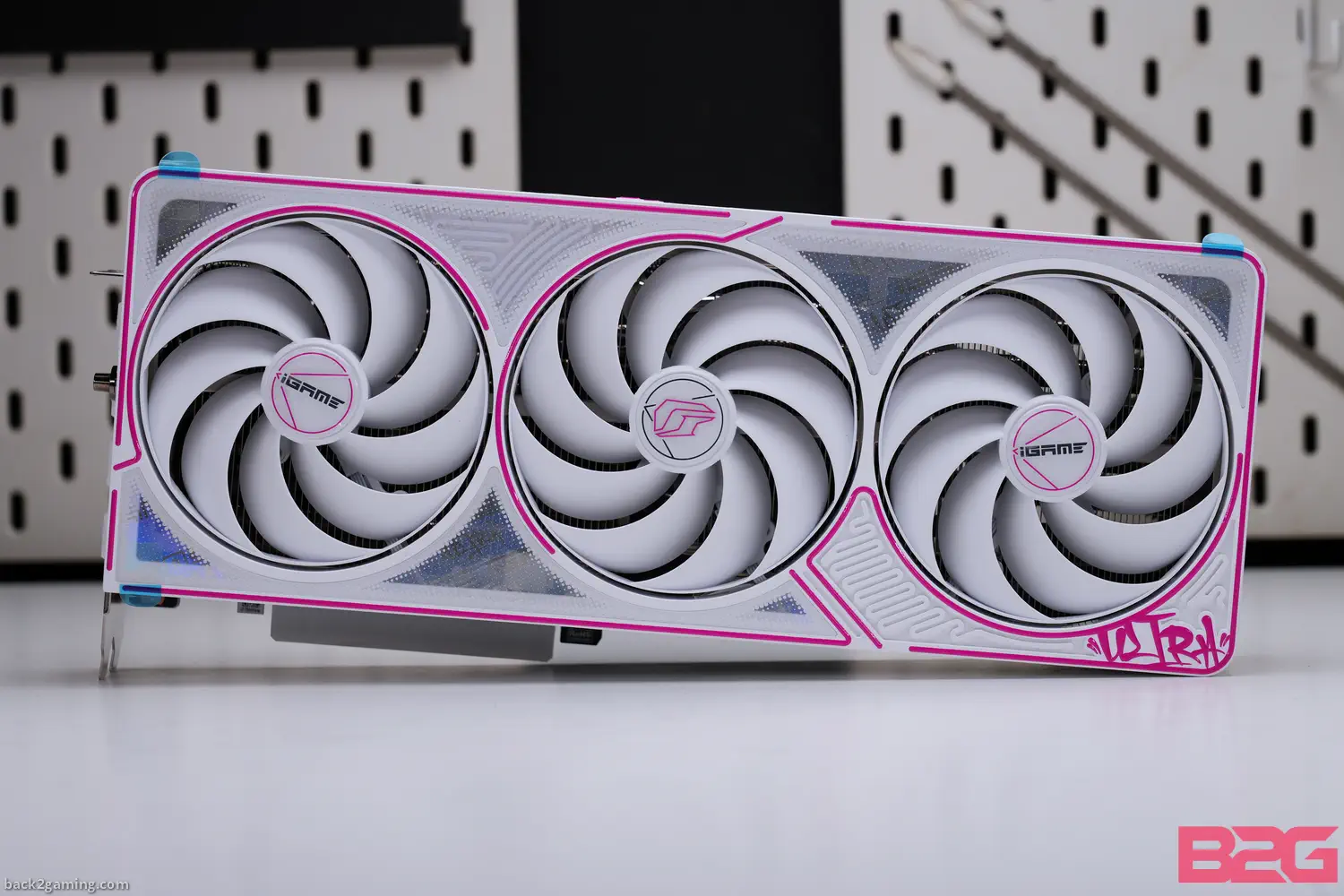
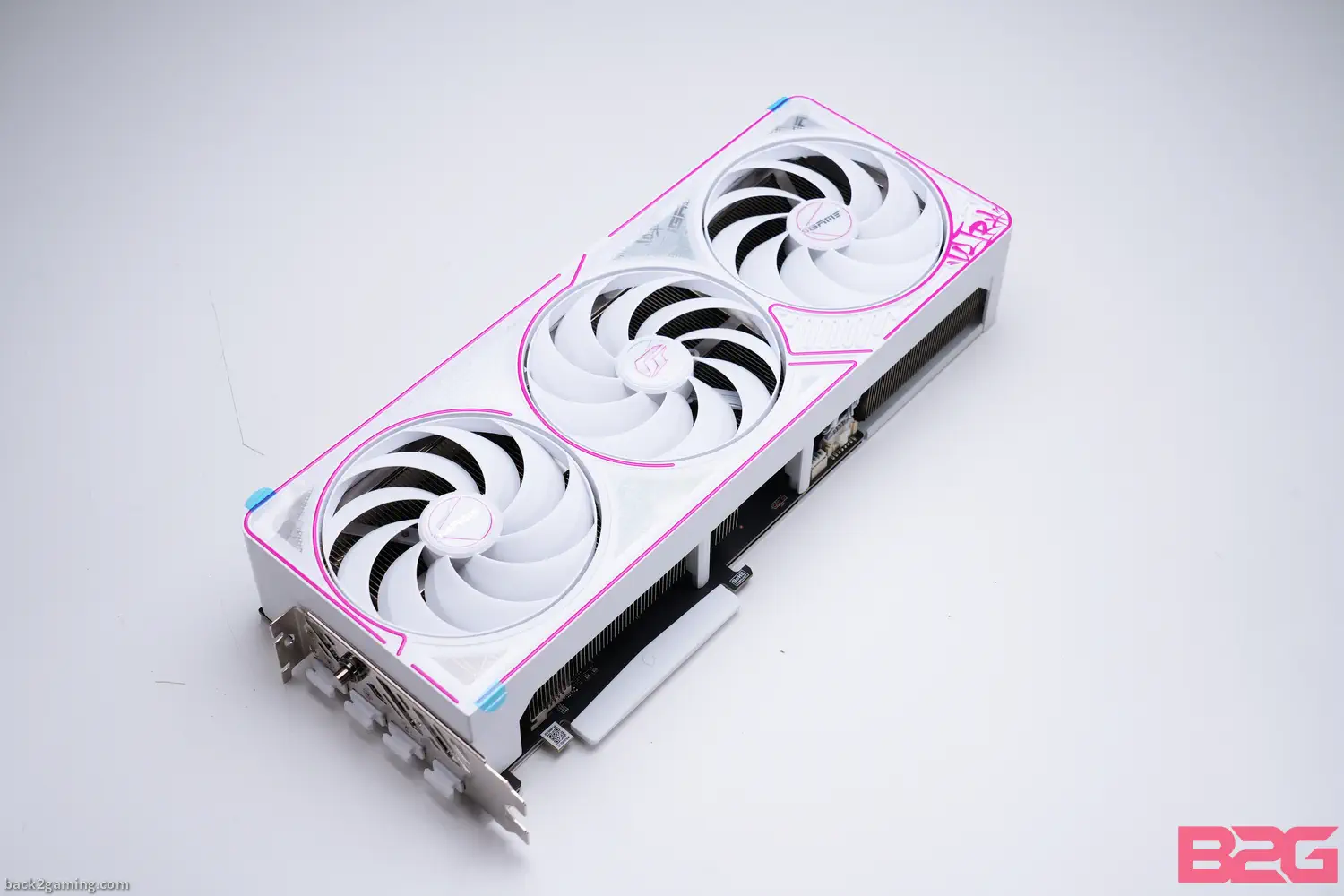
COLORFUL ships the iGAME RTX 5080 ULTRA W OC is a cardboard packaging with a full color shipping cover featuring the graphics card on the front. The W in the naming implies the White color variation although there is currently no non-white version of the Ultra 50-series from COLORFUL. The company offers the RTX 5080 Advance and their high-end Vulcan series in darker color schemes for countries that carry it.
The notable design motiff here is what COLORFUL calls the “graffitti” theme with their street-style tags and typography. The ULTRA text itself is easily close to Street Fighter’s font which has been adopting the hiphop subculture in the last 3 installations of the game. To give it certain flash, COLORFUL is opting for a neon pink on top of the white for the trims and highlights, giving it a very bright sillhoutte.


The gallery above shows us the card’s physical trait including its 3-lot cooler design, the shroud, and the backplate.

COLORFUL uses a wide coldplate to mount the card to the GPU with the rest of the plate cooling the video memory components. A bit further we see parts making contact with the power delivery array of the card. Very traditional layout and the fins are relatively common but effective.

A standard trait of COLORFUL graphics card since the GTX 10-series is the presence of a 1-click Turbo button at the back on select series. Typically found on higher-end iGame cards, the Turbo button bumps up core clocks with a factory OC. Users can still push the card further with their preferred GPU utility.


COLORFUL features a lightbar on the shroud facing the side away from the PCIe slot. This has a stock hotpink glow and is the only illuminated part of the COLORFUL RTX 5080 ULTRA W OC card.
The COLORFUL iGAME RTX 5080 ULTRA W OC is rated for 360W via 12VHPWR connector.

The included 3x 8-pin PCIe to 12VHPWR converter is done in white to compliment the color scheme.
Power Draw, Temperature and Clock Speed Analysis
Given that most cards will boost all the way to their highest potential, the numbers we see here should be a good indicator of what to expect from these cards in general. Results are captured via inline power metering instruments primarily Powenetics v2 by Cybenetics/Hardware Busters for accurate card-only data capture.
Occassionally, we use PCAT v2 (or v1) for FrameView-related functionalities. Powenetics v2 is the modern iteration of our original Powenetics system licensed from Cybenetics Labs and allows more thorough read-outs for the entire system including the CPU power, GPU power (+PCIe slot) and the system power overall. This removes the guess work from taking power readings from differing GPU APIs and provides consistent readings regardless of vendors. It integrates directly with CapFrameX hence all our capture data have inline power readings.
Clock Speed Behavior Under Load
It is possible to push workloads to a GPU to attain a fixed power consumption but real-world games and graphics applications do not operate this way. Modern GPUs can boost way past their base clock and with adequate cooling, max out their TGP budgets. The chart below exposes how the GPU behaves in relation to power and temperature. It also shows us how good the cooling keeps up.


The COLORFUL iGAME RTX 5080 ULTRA W OC’s cooler in Turbo Mode is very relaxed during intial load causing the spike in temperature in the opening which it takes a bit of time to adjust to as the fan winds up. Due to the initial higher temp, the fan gets aggressive dipping our temp closer to 60*C before it normalizes a few degrees higher.
Performance Testing – Setup & Methodology

Processor: Ryzen 7 9800X3D
Memory: G.Skill Trident Z5 NEO RGB DDR5-6000 CL30-38-38-96
Storage: Kingston FURY Renegade 2TB SSD, 8TB iSCSI LUN over USB4 Thunderbolt
PSU: FSP Hydro G Pro 1000W
Cooling: Arctic Liquid Freezer III 360
Monitor: ROG PG27UQ 4K 144hz HDR1000
VGA: Listed
For a full-hardware workout, visit https://benchmarks.ul.com for our system warm-up and stress test of choice. We have now switched to a full 20-minute run of Speed Way stress test to warm-up our graphics cards as well as capture our clock speed chart.
For benchmarking methodology please see our game benchmarking method guide.
Test results are gathered and produced on CapFrameX. This makes it easier for use to get both line graph comparison and raw averages without extra tools. Simply the easiest tool for benchmarking and its available for everyone to use, free of charge. Check it out at capframex.com.
Since this is a GPU review, we benchmarked the area of the games that put heavy load on the GPU.
All our test runs are repeatable, click the links below for area and details. Read our benchmarking methodology.
For Q1 2025 we’re using these sets of games:
- Counter-Strike 2: Mirage map custom scene
- DOTA2 – Dacha Dubai 2024: Xtreme Gaming vs. Team Liquid [56:25]
- PUBG Battlegrounds – Custom Scene
- Rainbow Six Siege: in-game benchmark
- Call of Duty Black Ops 6 – in-game benchmark
- Baldur’s Gate 3 – Lower City area custom loop
- Black Myth Wukong – Forest of Wolves loop (just past Wandering Wight, along the stream) [RT]
- Cyberpunk 2077 – in-game benchmark [RT]
- F1 2024 – Singapore, night time, wet (in-game benchmark) [RT]
- Ghost of Tsushima – Kushi Temple
- Hogwarts Legacy – Hogsmeade Square loop [RT]
- Horizon Forbidden West – Devil’s Grasp loop
- The Last of Us Part I – Game prologue, town panic area
- Marvel’s Spider-Man 2 Remastered – Financial District ground level
- Microsoft Flight Simulator 2024 – Melbourne discovery
- Ratchet & Clank: Rift Apart – Nefarious City loop
- Resident Evil 4 [RT]
- Starfield
- Warhammer 40K: Space Marines 2
To be added:
- God of War: Ragnarok
- Marvel Rivals
- Monster Hunter Wilds
- Delta Force
See our Youtube playlist for benchmark sequences.
Note: Proprietary technologies of NVIDIA like PCSS, HBAO+, and HairWorks work on AMD GPU’s BUT to maintain uniformity amongst GPUs, these have been turned OFF. Ray tracing has its own dedicared performance section. Upscaling technologies are covered in their own dedicated articles. Upscaling summary will be briefly presented in this section.
For this test, only the out-of-box normal mode will be tested. Most cards that have dual BIOSes for Quiet and Performance will be tested in Performance mode.
Notes:
- All data are gathered from exactly the same system, with exactly the configuration we list here. No data is reused from another system or from any variations. We gather data from only one system as indicated here.
- Graphics cards are allowed to heat up prior to benchmarking. Cooler graphics cards may boost higher than normal.
- Following up on the above, we try to enjoy the game and play a bit before proceeding to the actual benchmark scenario. This allows us to detect any other problems like stuttering, frame skipping, or any other problems before recording data.
- Games that receive graphical updates that affect performance like DOTA2 moving from DX9 to DX11, Rainbow Six Siege changing its detail presets, or any big patch that affect performanc in general etc. will be retested completely.

Note: All tests were done on the Turbo Mode enabled.
Counter-Strike 2

Released: 2023 | DirectX 11 | Source 2
DOTA 2

Released: 2013 | DirectX 11 | Source 2
PUBG Battlegrounds

Released: 2017 | DirectX 11 | Unreal Engine 4
Rainbow Six Siege

Released: 2015 | DirectX 11 | AnvilNext 2.0
Baldur’s Gate 3

Released: 2023 | DirectX 11 | Divinity Engine 4.0
Black Myth Wukong

Released: 2024 | DirectX 12 | Unreal Engine 5
Cyberpunk 2077

Released: 2020 | DirectX 12 | REDengine 4
F1 2024

Released: 2024 | DirectX 12 | Ego Engine 4.0
Ghost of Tsushima: DIRECTOR’S CUT

Released: 2024 | DirectX 12 | Sucker Punch Studio In-house Engine
Hogwarts Legacy

Released: 2023 | DirectX 12 | Unreal Engine 4
Horizon Forbidden West

Released: 2023 | DirectX 12 | Decima Engine
The Last of Us Part 1 Remastered

Released: 2023 | DirectX 12 | In-house Engine
Marvel’s Spider-Man 2

Released: 2025 | DirectX 12 | Insomniac Engine 4.0
Microsoft Flight Simulator 2024

Released: 2024 | DirectX 12 | In-house Engine
Ratchet & Clank: Rift Apart

Released: 2023 | DirectX 12 | Insomniac Engine 4.0
Resident Evil 4

Released: 2023 | DirectX 12 | RE Engine
Starfield

Released: 2023 | DirectX 12 | Creation Engine 2
Warhammer 40,000: Space Marine II

Released: 2023 | DirectX 12 | Swarm Engine
Ray Tracing
Aside from a pair of games, all of our games after our esports batch are tested with ray tracing enabled. The chart below shows the overall ray tracing performance of the GPUs tested.
Ray Tracing Geomean Performance (6 Games)
DLSS4
DLSS 4 represents NVIDIA’s next major advancement in AI-assisted graphics, transitioning from convolutional neural networks to a Transformers-based model. This shift allows the technology to interpret and refine frame data more holistically, enhancing everything from resolution upscaling to texture detail and motion clarity.
Unlike previous iterations that merely supplemented rendering, DLSS 4 aligns seamlessly with the new “Multi Frame Generation” feature, letting the GPU extrapolate multiple future frames from a single rendered one—effectively multiplying framerates. Even in lower-quality modes, DLSS 4 demonstrates a marked improvement in image fidelity over earlier versions, highlighting its ability to preserve clarity in fast-paced scenes.
By integrating closely with the Blackwell architecture’s revised SM layout, neural shader objects, and Flip Metering display engine, DLSS 4 cements its role as a key component of the RTX 50-series’ AI-driven rendering approach. This synergy points to NVIDIA’s long-term ambition of pushing real-time graphics beyond conventional ray tracing and traditional upscaling solutions.
NVIDA promises multiple DLSS4 title on launch day from this post on their website, but as of testing in late January after launch, many of these titles have yet to implement multi-frame generation.
That said, we use the multi-frame generation in Hogwarts’ Legacy to demonstrate the improvements that each factor brings.
Conclusion

The COLORFUL iGAME RTX 5080 ULTRA W OC is an appealing card visual and performs quite well in terms of overall performance. There’s not a lot to dislike about it except for the lack of a black version (a iGame RTX 5080 ULTRA OC so to speak), an issue resolved by opting for the possibly pricier Vulcan or Advance from COLORFUL. Both these products have their merits but they do drop the neon pink highlights and graffiti stylings that the Ultra brings.
For the card itself, we can see COLORFUL managing the power input despite the swings upwards of 425W on the 12VHPWR while keeping the card at a cool 64*C under heavy gaming load. The fans can passively cool the GPU underload down to 75*C for a minute before running its fans, initially at 75% before dropping to 60%. Depending on how susceptible you are to noise, inside a case, the COLORFUL iGAME RTX 5080 ULTRA W OC’s fan noise is a dampened hum at 60% but will get quite audible at >80% although unless you’re using this card in a tight case, it will mostly hover at 70% fan speed tops when loaded.
This review assumes you’re interested already interested in buying an RTX 5080, regardless if you have an RTX 40 or RX 7000 or older. Most reviews of the card voices a strong focus in generational uplift, something that tech as a whole seems to be struggling with. Smartphones, desktop CPUs, or most other components have reach a point that we have not seen a significant shift in products for the last few years. Ultimately, the case of the RTX 50-series is a polarizing one. Will the RTX 5080 be better than the RTX 4090? From a pure gaming standpoint, it depends on the game itself but in outright raw performance and intended applications, the RTX 4090 still perched on a higher position.
NVIDIA is in a position to hold-out or not care at all but continues their cadence in GPU releases. While the GTX 10-series and RTX-30 series marked a significant bump in performance, the RTX 40-series and RTX 50-series are anchored on the existence of their halo models the RTX 4090 and the RTX 5090 being products of absolute class dominance that topping that is going to require a shift in the fundamentals of rendering itself as physics is becoming the apparent barrier in getting performance faster on current silicon.
That said, Hollywood themselves would probably relish in NVIDIA’s Neural Rendering if it can cut scene generation times by half but this isn’t reflected by segment of the gaming industry, still vocally rejecting generative AI regardless of vendor but most of the vitriol directed at NVIDIA. With Sony, AMD, and Intel also aboard AI upscaling, NVIDIA’s approach for neural rendering could be a divergent path towards the progression of graphics instead of the linear path to, well, path-traced rendering.
All in all, the RTX 5080 has a certain allure thanks to DLSS4 and MFG and barring the noise surrounding availability and pricing, the RTX 5080 is a viable platform for upgraders on lesser cards even on the RTX 40 series (RTX 4070 or less). For now though, as good as DLSS4 is, adoption is a barrier so relying solely on the premise that the RTX 5080 is parallel upgrade to the RTX 4080/4080 SUPER, then it should make it easier for those that want to jump on the RTX 50 series era.
The COLORFUL iGAME RTX 5080 ULTRA W OC is an excellent essentials-first card for those looking for one of the most competitively priced RTX 5080 cards in the Philippines. With an official distributor price of PHP79,999 on launch, street prices for the COLORFUL iGAME RTX 5080 ULTRA W OC has seen it go below PHP69,000 when bought with a complete system. Straight retail pricing will vary along with dealer’s pricing. Check with your favorite dealer for pricing and availability.
Not all is bright and sunny for COLORFUL as it carries only a 1-year warranty. Personal anecdote aside, that is quite short especially if we’re comparing pricing head-on. So far, ZOTAC still wins with 5-year total but availability is still up in the air while ROG follows with 4-years but is a very elite club where price isn’t the only barrier as availability is also very restricted. The rest of the market carry either 2- or 3-years but pricing still varies so I highly advise to weigh your risks.
Barring pricing and warranty, the COLORFUL iGAME RTX 5080 ULTRA W OC 16GB-V is an effective starter design for COLORFUL and is very likable in its physical design. Despite bearing a white color scheme, its bright colorway makes it a popping center piece for high-contrast build motiffs.
As mentioned, COLORFUL Philippines backs the COLORFUL iGAME RTX 5080 ULTRA W OC with a 1-year warranty. This will vary by region for non-Philippine residents so check with your local COLORFUL social media pages. Still, its a nice card and performs as expected while being cool and quiet. I give it my B2G Recommended Seal!



pattern kong napansin ngayon is odd number rtx release nagiging high power draw, while yung even numbered rtx dun bumabanat sa efficiency
Adrian R*******z tick-tock cycle nvidia edition hehe 3 years ang cadence with mid-life refresh
https://www.facebook.com/share/1Ba84Dmem1/
imports ng US yan par papasok sa kanila, basically kung usapang SRP, parehas na halos US and PH
Still no restock
Le M***n Confirm ko today if kelan next batch of supplies